Gastrointestinal (GI) cancers—or cancers of the digestive tract—are among the most common types of cancers in the United States.1 GI cancers affect a wide range of organs along the digestive tract, including the esophagus, stomach, small intestine, liver, pancreas, gallbladder/biliary tract, colon, and rectum.
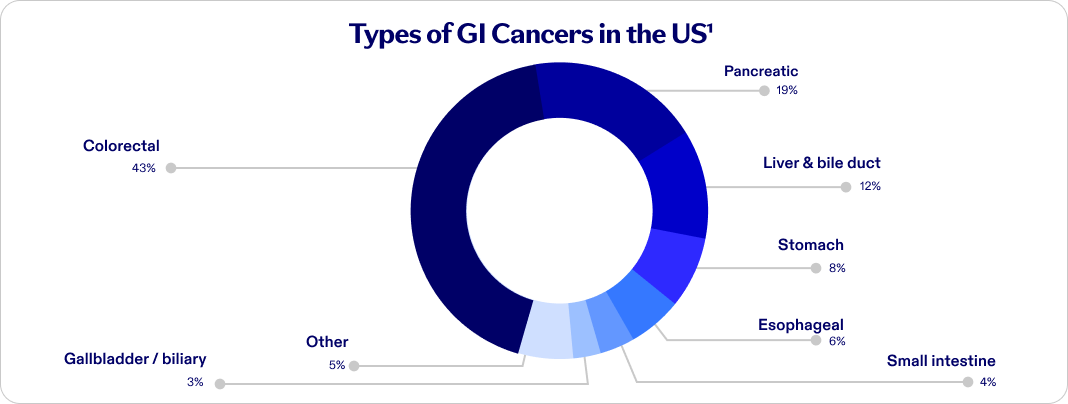
GI cancers can affect anyone regardless of age, race, ethnicity, diet, and health history. Despite recent advancements, clinical trials remain essential for continuing to improve and refine GI cancer treatments.
Clinical trials help researchers learn how safe and effective potential medical treatments are when given to participants. All medicines that become available today are first tested in hundreds to thousands of clinical trial participants. Clinical trials are important to help advance treatment options. When joining a clinical trial, you play an important role in that progress.
The decision to join a clinical trial is personal, and it is yours. Participating in a clinical trial has the potential to impact you as well as many others affected by the same or a similar medical condition.


Common eligibility criteria in GI cancer clinical trials
Every clinical trial has requirements to participate, called eligibility criteria. They may include:
Type of GI cancer
Refers to the specific type of GI cancer the clinical trial is studying including colorectal, pancreatic, liver & bile duct, stomach, esophageal, small intestine, gallbladder/biliary, and others.
Stages of GI cancer (Stages 1-4)
This describes where the cancer is in the body and if it has spread outside of the GI tract.
Biomarkers
The type of biomarker (if any) detected with your GI cancer. Cancer biomarkers are genes, proteins, or other substances that can be tested to reveal important details about a person’s cancer. Cancer biomarkers play a crucial role in early detection and prevention, personalized treatment options, treatment monitoring and evaluation, prognosis, and risk assessments.
Treatment
Whether or not you are currently on medication or have previously received treatment (approved or investigational) for your GI cancer or other medical conditions.
Health
Your age and overall health, including current or past medical conditions. The study doctor will be able to go into more detail as this varies by clinical trial.
Refine your search
Representation is key
Pfizer recognizes that to better understand health needs and the impact of our medicines, it is important that clinical trial participants represent the communities in which we conduct our trials and those disproportionately impacted by the disease we aim to address. Many factors controlled by genetics, including race, ethnicity, and gender, can impact how people respond to a medicine and/or vaccine. So, it’s very important that clinical trials include people of all backgrounds.
- Men are generally at a higher risk than women of developing GI cancer.2
- Black Americans are 20% more likely to get colorectal cancer and about 40% more likely to die from it than other groups.3
- 12% of colorectal cancers in 2020 were diagnosed in people under the age of 50.1
- Compared to (non-Hispanic) White people, Hispanic people have almost 2 times higher incidence of stomach and liver cancers.1
- Incidence and mortality in American Indian and Alaskan Native people is approximately twice that in White people for cancers of the liver and stomach, and 50% higher for colorectal cancers.1

1. American Cancer Society. Cancer Facts & Figures 2025 [PDF]. Published 2025. Accessed September 22, 2025. https://www.cancer.org/content/dam/cancer-org/research/cancer-facts-and-statistics/annual-cancer-facts-and-figures/2025/2025-cancer-facts-and-figures-acs.pdf.
2. Jiang, J., Xie, Z., Wang, Q. et al. Epidemiological trends in gastrointestinal cancers and risk factors across U.S. states from 2000 to 2021: a systematic analysis for the global burden of disease study 2021. BMC Public Health 25, 43 (2025).https://doi.org/10.1186/s12889-024-21192-3.
3. Colorectal cancer rates higher in African Americans, rising in younger people. American Cancer Society. September 3, 2020. Accessed October 7, 2025. https://www.cancer.org/cancer/latest-news/colorectal-cancer-rates-higher-in-african-americans-rising-in-younger-people.html.
In clinical trials, participant safety is the top priority. Before you participate, you will be given all the details about the trial, including potential benefits and risks of taking part. If you are eligible to participate in a trial, your health will be regularly monitored while in the clinical trial.
If the study doctor determines that a clinical trial is a good fit for you and you decide to take part, it’s important to remember that you have the final decision whether to participate. You are free to stop being in the trial at any time and for any reason.
Depending on the design of the clinical trial, participants could receive either the study medicine or a standard of care treatment (the established treatment that is currently approved for people with a disease). In some clinical trials, participants may receive a placebo in addition to a standard of care treatment.
Pfizer generally covers the cost of the study medicine and all procedures that are part of our clinical trials. We are also committed to reimbursing participants and a caregiver for reasonable trial-related costs (eg, travel, parking, meals) as allowed by the institution and by ethics committees. Additionally, travel services such as transportation to and from your visits may be an option for you as well if allowed by the institution and ethics committee. Arrangements may vary between each clinical trial and institution; therefore we encourage you to discuss this with the study doctor.
It is possible your condition or health may improve, worsen, or stay the same while you are taking part in a clinical trial.
Some potential risks include:
- All medical treatments (study or approved) may have side effects. Before joining any clinical trial, the study staff will explain all the known potential side effects of the study medicine or any other treatments you may receive during your participation, and any potential risks or discomfort from the study procedures (eg, the side effects of having a blood test or biopsy).
- Potential risks and discomforts will be included in the Informed Consent Document (ICD) that you will have to sign before taking part in any clinical trial.
Some potential benefits include:
- Participation may help people in the future by increasing our understanding of the study medicine.
- The research team will regularly monitor your health during the clinical trial.
The goals of a clinical trial are also called endpoints. These are results that researchers measure in a clinical trial to see how a study medicine, when given alone or in combination with other medication, affects people. The goals, or endpoints, vary study by study but may include:
- Whether the study medicine is safe and easy to take
- Whether life expectancy is extended
- The percentage of patients who respond to the study medicine
- Whether there is an increase in the time that the cancer doesn't spread
- Whether there are changes to or improvements in quality of life
This is not a complete list but, if you are considering a clinical trial, the study team can review this information with you.
A description of each clinical trial and the results are available on ClinicalTrials.gov, as required by U.S. Law. You can search this website at any time.
If you choose to participate in a Pfizer clinical trial, we invite you to join other alumni by registering at www.PfizerClinicalTrialAlumni.com where, among other things, you will have access to news, resources, and general study results (also known as the Plain Language Study Results Summary) as soon as they become available. For some studies, participants may access a portion of their individual data.