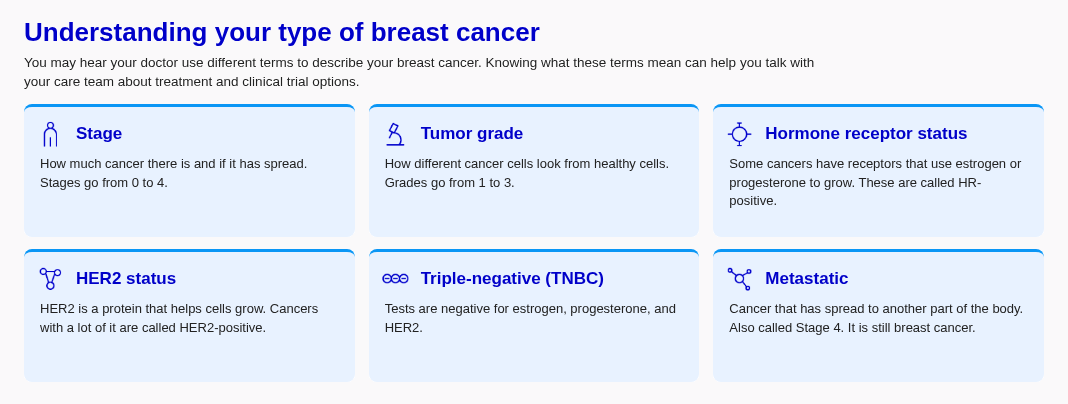
Breast cancer affects both women and men at different ages and stages of life and each person’s experience is personal. Doctors use information about your cancer, such as its stage, grade, and biomarkers, to help plan treatment.
Learning more about your diagnosis can help you understand the options that may be available to you, including clinical trials.
In clinical trials, researchers learn more about breast cancer and possible new treatments, including how safe they are and how they may affect people. The decision to join a clinical trial is personal, and it is yours. By taking part, you may help researchers learn more about breast cancer and future treatment options.

Common eligibility criteria in breast cancer clinical trials
Every clinical trial has requirements that help determine who may take part. These are called eligibility criteria. They may include:
Type of breast cancer
The type of breast cancer being studied, such as HR-positive, HER2-positive, or triple-negative breast cancer.
Stage of breast cancer
The stage of the cancer and whether it has spread to another part of the body.
Previous treatment
Treatments you are receiving now or have received in the past.
Other features of your cancer
Other information about the cancer that may be important for the trial, such as tumor grade or specific biomarkers.
Health
Your age, overall health, and current or past medical conditions. Some trials may also consider menopausal status. The study team can explain the requirements for a specific trial.
Representation is key
Breast cancer doesn’t affect all communities in the same way. That’s why it’s so important for clinical trials to include people of all backgrounds. This can help researchers better understand breast cancer and how medicines may affect different people.
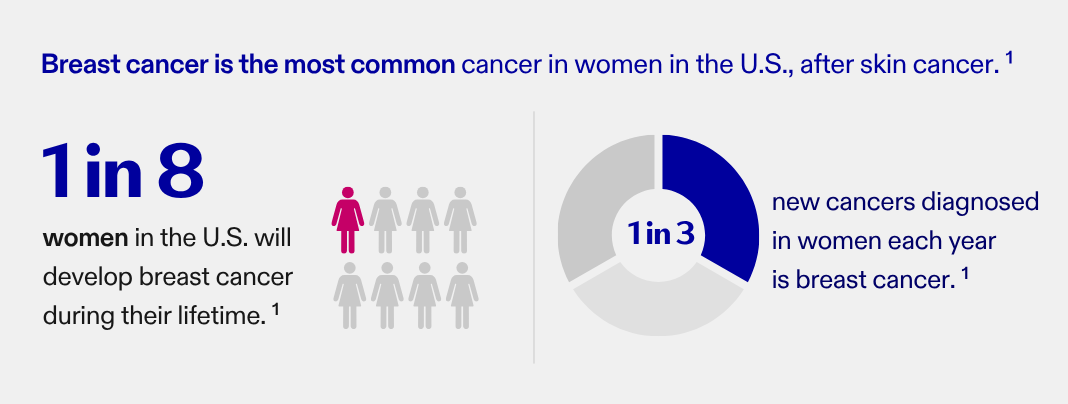
- Breast cancer is becoming more common across racial and ethnic groups, with some of the fastest increases among Asian American and Pacific Islander women and Hispanic women.1
- Black women and American Indian/Alaska Native women are less likely than some other groups to be diagnosed when breast cancer is still at an early stage.1
- Breast cancer is diagnosed slightly more often in White women than in Black women, but Black women have lower survival rates.1

Refine your search
Frequently asked questions
Every clinical trial has its own eligibility criteria. These may include your type and stage of breast cancer, previous treatments, overall health, and other medical information. The study team will review the criteria and let you know whether you may be eligible.
Participant safety is a top priority. Before you decide whether to join, the study team will explain the trial, including the possible risks and benefits. If you join, the study team will check your health throughout the trial. Taking part is your choice, and you can leave at any time, for any reason.
It depends on how the clinical trial is designed. Everyone in breast cancer trials receives active treatment: you may receive a study treatment or a comparator. The study medicine is what is being researched. The comparator treatment is medicine(s) already approved and commonly used to treat breast cancer. In some trials, a placebo is given along with standard treatment. The study team will explain the treatment groups before you decide whether to take part.
Costs and support vary by trial and study site. Ask the study team what costs you may have and what support may be available, such as help with travel, parking, or meals.
Your health may get better, get worse, or stay the same during a clinical trial. Study medicines and procedures may cause side effects or discomfort. Before you decide whether to join, the study team will explain the known risks and possible benefits in the informed consent document. Taking part may also help researchers learn more about breast cancer and future treatment options.
Cancer clinical trials are designed to answer specific research questions. Researchers may study how safe a medicine is, how the cancer responds, how long a treatment helps keep the cancer from growing or spreading, and how treatment affects daily life. Each trial has different goals. The study team can explain what will be measured in the trial you are considering.
Information about registered clinical trials and available study results can be found on ClinicalTrials.gov. For some Pfizer trials, participants may also be able to view a plain-language summary of study results through Pfizer Clinical Trial Alumni when results are available.
The study team will explain how your personal information will be collected, used, and protected. You can also find these details in the informed consent document.
References
American Cancer Society. Key Statistics for Breast Cancer. Updated June 23, 2026. Accessed October 12, 2026. https://www.cancer.org/cancer/types/breast-cancer/key-statistics.html